

You walk into the gym, load your working weight onto the bar straight away and start your first heavy set. Sound familiar? That first set often feels stiff, heavy and shaky. A good warm-up for strength training prevents that and helps you get more out of your strongest sets.
In this article you'll learn how to warm up in about ten minutes, how many warm-up sets you need and which mistakes you'd better avoid. Including a concrete example you can use tomorrow.
Why a warm-up for strength training makes sense
A warm-up raises your body temperature and blood flow, loosens up your joints and gets your nervous system ready for heavy work. Just as important: you practise your technique with light weight before things get heavy. That makes your working weight feel more familiar and lets you focus fully on your form.
Whether a warm-up prevents injuries is less clear than often claimed. The research on it is mixed. What is clear: your first heavy set almost always goes better when your body and technique are already up and running.
General and specific warm-up: what's the difference?
General warm-up
A few minutes of easy movement to raise your heart rate and body temperature. Think cycling, rowing, a brisk walk on the treadmill or a short round of bodyweight exercises. You want to get warm, not tired.
Specific warm-up
This is where you prepare for the exercise you're about to do. You move the joints you need and do warm-up sets with increasing weight in exactly the same exercise. This part gives you the biggest performance gain.
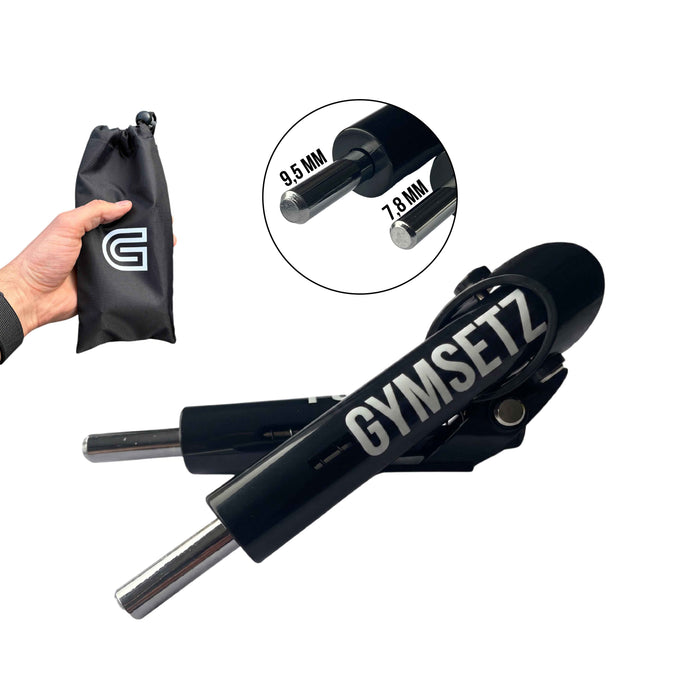
GYM ESSENTIALS SET
€49,00
Everything you need for heavy training, in one set. With the Gym Essentials Set you get the three Gymsetz favourites together and pay €49 instead of...
View productHow to build your warm-up in 4 steps
Start with 5 minutes of easy cardio
Pick something low-key like the exercise bike or rower. A pace where you can still talk easily is enough.
Loosen up the joints you'll be using
Do dynamic movements: arm circles and band pull-aparts for an upper body session, leg swings, hip circles and bodyweight squats for a leg session. Short and controlled.
Activate your muscles with light exercises
A set of glute bridges before your squat or a few light face pulls before your bench press help you feel the right muscles before you go heavy.
Do warm-up sets with increasing weight
Start with an empty bar or light weight and work up to your working weight in a few steps. The heavier your working set, the more steps you need in between.
Warm-up sets: an example with 100 kg
Let's say you're squatting 3 sets of 5 reps with 100 kg today. Your warm-up could look like this:
| Set | Weight | Reps |
|---|---|---|
| Warm-up set 1 | 20 kg (empty bar) | 10 |
| Warm-up set 2 | 50 kg | 5 |
| Warm-up set 3 | 70 kg | 3 |
| Warm-up set 4 | 85 kg | 2 |
| Working sets | 100 kg | 3 x 5 |
Notice the pattern: the weight goes up and the reps go down. That way you don't get tired before your real sets start. Not sure what your max is? Our guide on calculating your 1RM gets you a long way. Keep the rest between warm-up sets short, and before your first working set take the same rest you'd take between working sets. Read more in our article on rest time between sets.
Tip
Do you use wrist wraps or lifting straps? Do your lighter warm-up sets without them and only put them on for your heaviest warm-up set or your working sets. That way your wrists and grip get trained too.
Static stretching or dynamic movement?
Long static stretching right before heavy sets can temporarily lower your strength a little, according to several studies. Short stretches have little effect on that. For most lifters, dynamic movement is therefore the more logical choice before training. Want to work on your flexibility? Do it after your session or at a separate time.
Do you have a specific limitation, like a stiff ankle when squatting? Then targeted mobility work for that exercise can actually be useful. Also check out our guide to proper squat technique.
Common warm-up mistakes
- Skipping it entirely: jumping straight to your working weight feels efficient, but your first sets often go worse.
- Warming up too much: twenty minutes of cardio and ten high-rep warm-up sets mostly just make you tired.
- Jumps that are too big: going from an empty bar straight to your working weight gives your technique no chance to settle in.
- Only warming up the first exercise: moving from squats to bench press? Do one or two warm-up sets there too. See also our bench press technique guide.
- Ignoring pain: if something doesn't feel right during your warm-up, don't force it. If it keeps coming back, have it checked by a doctor or physiotherapist.
Tip
Write your warm-up sets in your training log, just like your working sets. That gives you a fixed routine every session and you won't have to think about it anymore.
Frequently asked questions about warming up for strength training
How long should a warm-up for strength training take?
For most people about 10 to 15 minutes is enough: a few minutes of general warm-up, some dynamic movement and then your warm-up sets. Heavier sessions usually call for a few more warm-up sets.
How many warm-up sets do I need?
That depends on how heavy your working set is. With a light weight one or two sets will do; with a heavy weight you can take three to five steps, like in the example above.
Do I need to warm up for machine exercises too?
Yes, although it can be shorter. One or two light sets on the machine are often enough, especially if you're already warm from earlier exercises.
Does a warm-up set count towards training volume?
Usually not, because warm-up sets stay far from failure. When counting your sets per muscle group per week, you generally only count your working sets.
Summary
A good warm-up for strength training doesn't have to take long: a few minutes of cardio, dynamic movement and a handful of warm-up sets with increasing weight. That way you start your heavy sets with a warm body and sharp technique. Want everything at hand for push, pull and machines? Check out the Gym Essentials Set or discover more articles in the Fitness Hub.
Read next
View
Training to failure: how close to failure should you train for muscle growth?
Should you take every set to failure? Learn what research says, what RIR means...
View
Rest between sets: how long to rest for muscle growth and strength
How long should you rest between sets? Find the ideal rest time for muscle...
View
Sets per muscle group per week: how to plan your training volume
How many sets per muscle group per week do you need to build muscle?...
Ready to train stronger?
Discover all guides, programs and tools in the Fitness Hub.